
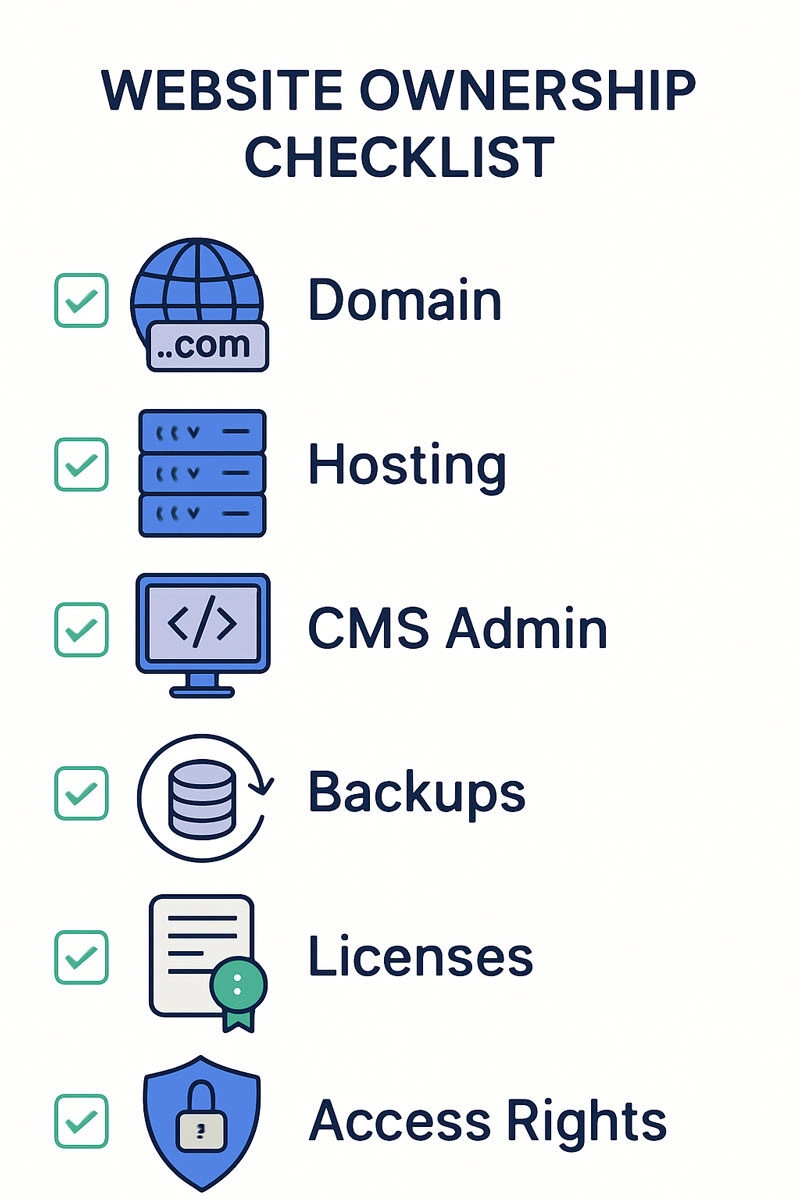
“Website ownership” is not a single setting or account. A business website can involve a domain registration, hosting, CMS, source files, design assets, copy, fonts, plugins, analytics and personal data. Different parties may control or license different parts. The agreement and account records should make that arrangement clear before a project begins.
Put control of critical accounts in writing
Decide which organisation or person registers the domain and has recovery access. Confirm who controls the hosting account, DNS, CMS administrator users, repository, deployment service, analytics and advertising accounts. Use business-controlled email addresses and more than one authorised administrator where appropriate. Store credentials securely and remove access when a person no longer needs it.
Access is not the same as ownership. A supplier may provide a licence to use a theme, font, plugin or stock image without transferring the underlying rights. The contract should list these components, their renewal costs, transfer rules and any limits on reuse. Define what happens to custom code, design files, written content and documentation when the engagement ends. Ownership and copyright depend on the agreement and applicable law; obtain legal advice if rights are unclear or disputed.
Agree the handover before work starts
Specify the handover format, deadline and responsible people. Include administrator access, domain and DNS details, hosting information, source code, content exports, licence records, backups and operating documentation where these are part of the scope. Identify any account or service that cannot be transferred, and decide how a replacement will be arranged.
Test the handover with a person who did not build the site. Confirm they can log in, deploy or update content as agreed, restore a backup and contact the relevant providers. A password list alone is not a handover if the site still depends on undocumented systems or accounts owned by the former supplier.
Handle personal data deliberately
List the services that collect or process customer information, who can access it and why it is retained. Agree how information will be exported, returned or deleted when the service ends. Malaysian personal-data duties depend on the business, activity and current law. This article is not legal advice; ask a qualified adviser to review contracts, data roles and retention requirements.
A useful pre-project checklist
- Name the account owner and recovery contact for each critical service.
- List licensed assets and recurring charges.
- Define deliverables, exclusions, handover and exit assistance.
- Keep a current inventory of users, systems, backups and dependencies.
- Review the arrangement when suppliers or staff change.
Clear ownership terms reduce operational dependence and make future supplier changes easier to plan. They do not remove the need for maintenance or specialist support.