
Medical schema markup can describe a clinic, practitioner, location or health topic in a consistent, machine-readable format. Search engines and AI crawlers that process Schema.org data can use it as additional context about what a page describes. It does not guarantee higher rankings, rich results, Knowledge Graph inclusion or citations in AI features. The markup must accurately reflect information people can see and verify on the website.
Key takeaways
- Use Schema.org types that match the visible page and the real organisation or person.
- Google supports only selected structured-data features in Search. A valid Schema.org type is not automatically a Google rich result.
- Keep clinical facts, credentials, locations and opening hours accurate, and have an appropriate person review health content.
- Validate the markup, then check how Google accesses the live page. Recheck it when the underlying information changes.
What is medical structured data?
Structured data is a standard way to label information about a page. Schema.org provides a shared vocabulary. JSON-LD is one format for adding this data, usually in a script element in the page source. Google recommends JSON-LD where practical, but also supports Microdata and RDFa for eligible Search features.
For a healthcare site, markup might describe a clinic, a practitioner, a medical service or the subject of an educational article. It gives machines additional context. It does not replace clear page copy, clinical review, accessible design or accurate business information.
Choose a type that describes the real page
MedicalClinic and local business information
MedicalClinic is a Schema.org type for a medical clinic. It can describe a clinic’s name, address, contact details, website and other relevant facts. Use it only where the page is about that clinic and the details are shown to visitors. For a physical location, Google recommends the most specific suitable LocalBusiness subtype and following its guidance for the fields it supports.
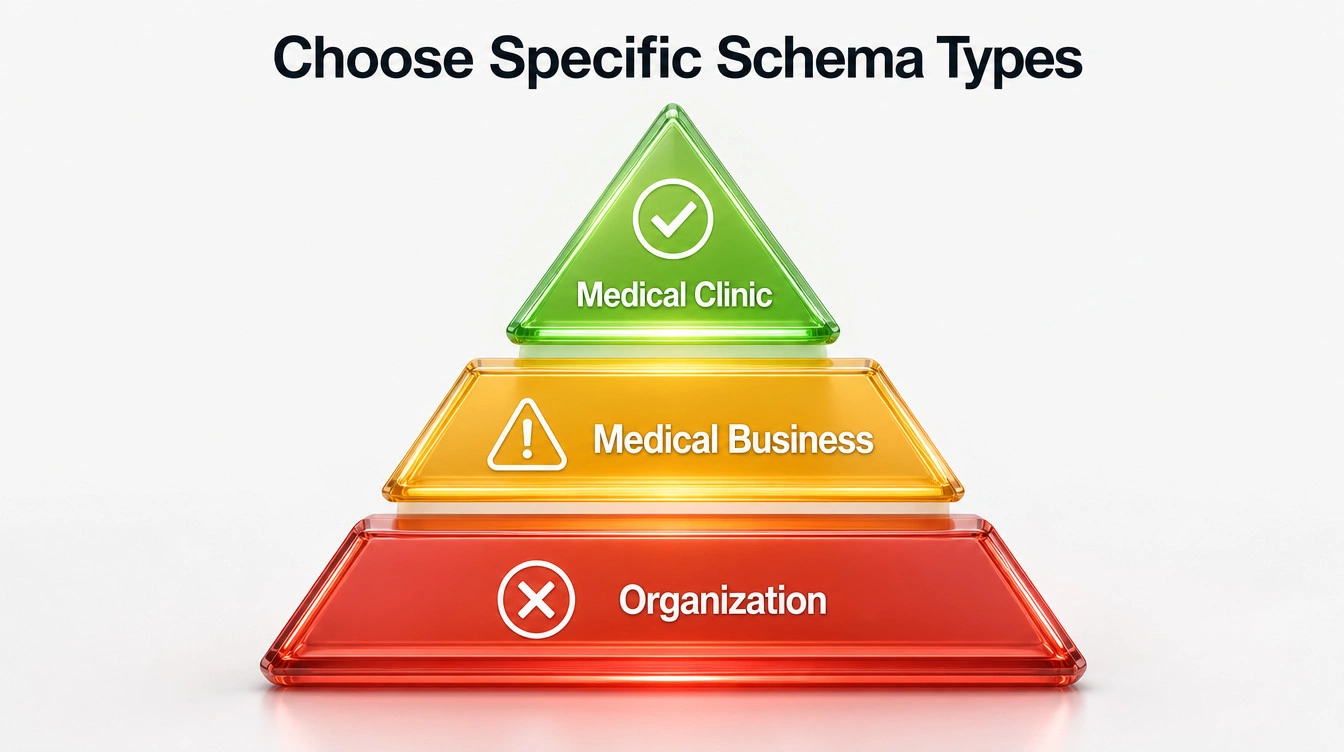
Do not assume that MedicalClinic itself produces a special Google medical rich result. Google documents a defined set of Search features, and structured data eligibility depends on the specific feature and its rules. A type can still describe information without creating a visible enhancement in Search.
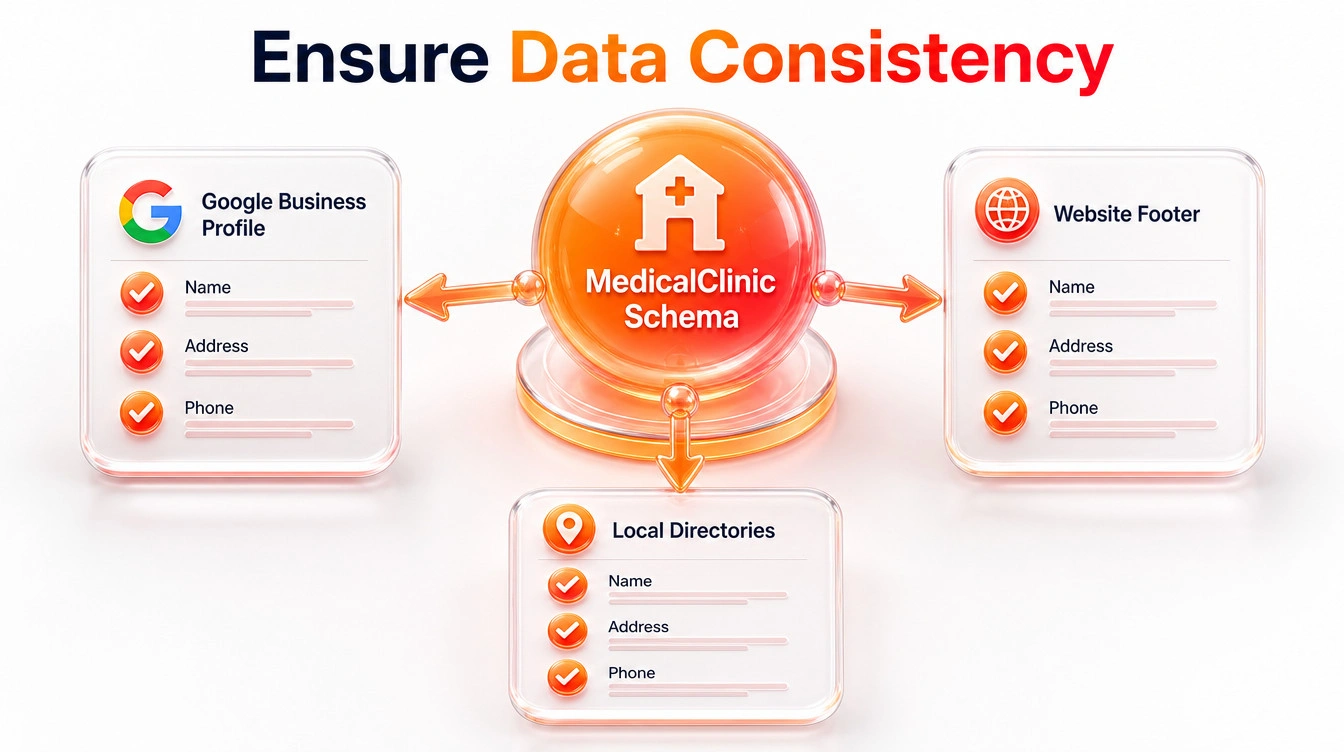
Put location information on a page that actually describes that location. If a clinic has several branches, represent each branch accurately rather than placing every address into one location record. Keep the website, Google Business Profile and other public business listings aligned where possible.
Physician and practitioner details
Schema.org’s Physician type can describe a physician. Use facts that are supported by the page and approved records, such as the person’s name, relevant role, clinic affiliation and professional information. Do not publish a registration number, qualification, specialty, hospital affiliation or award unless it is verified and appropriate to disclose.
Structured data does not establish that a practitioner is licensed, and it does not replace professional verification. A clinic should have a suitable clinical or compliance reviewer confirm names, qualifications and claims before publication. Requirements can vary by jurisdiction, so obtain qualified advice for the markets where the clinic operates.
MedicalCondition and health information
Schema.org includes types such as MedicalCondition, MedicalProcedure and MedicalWebPage. These can describe the subject matter of relevant content. They do not verify that a diagnosis or treatment claim is correct. The visible article should be written or reviewed by a person with appropriate clinical expertise, cite reliable sources where needed, and state its intended audience and limitations.
Only add medical codes or links to external clinical references when the code and its meaning have been checked by a qualified reviewer. Avoid attaching a condition or treatment type to a general service page simply to make it appear more specific.
A simple JSON-LD example
This example shows the shape of a clinic record. Replace every placeholder with verified information, and remove properties that do not apply. Do not publish the example values as real clinic details.
{
  "@context": "https://schema.org",
  "@type": "MedicalClinic",
  "@id": "https://example.com/clinic/#clinic",
  "name": "[Clinic name shown on the page]",
  "url": "https://example.com/clinic/",
  "telephone": "[Public clinic telephone number]",
  "address": {
    "@type": "PostalAddress",
    "streetAddress": "[Public street address]",
    "addressLocality": "[City or town]",
    "addressRegion": "[State]",
    "postalCode": "[Postcode]",
    "addressCountry": "MY"
  }
}
Use one stable @id for the same clinic entity across relevant pages. Do not reuse an example identifier or leave placeholders in production. Add opening hours, coordinates, images or other properties only when the information is accurate, current and useful to visitors.

Implementation checks for healthcare websites
Match the markup to visible content
Google’s general guidelines require structured data to represent the page and not mislead people. Do not mark up hidden claims, unverifiable credentials, reviews that are not displayed, or services the clinic does not offer. If an address, practitioner or service changes, update the page and its markup together.
Keep identity and location details consistent
Check clinic names, addresses and telephone numbers against the organisation’s approved source of truth. A branch should have its own accurate address and contact details. Resolve differences in spelling or formatting deliberately; do not copy incorrect information from an old directory listing into the website just to make every source match.
Treat FAQ markup carefully
FAQ content should answer real questions on the page. Google limits FAQ rich results to well-known, authoritative government and health websites, and it does not guarantee a display even when markup is valid. A clinic should not add FAQ structured data on the assumption that it will expand its Search listing. Keep useful answers for readers regardless of whether a rich result appears.
Structured data can give AI crawlers clearer context
Structured data presents page meaning to crawlers in a more organised form, and it must match what the page says and shows. Search engines and AI crawlers that fetch or process Schema.org data may use it as additional context about the organisation, person, service or subject a page describes. Support and use vary by system, so do not assume every crawler will read or act on the markup.
For Google’s AI Overviews and AI Mode, Google says no additional technical requirements or special schema are needed. Normal SEO fundamentals still apply, and structured data should match visible text. Add accurate markup to clarify the page, not as a promise of AI visibility or citation.
Schema is one part of technical SEO
Adding a JSON-LD script is one implementation step. The wider work is making sure important content can be crawled and indexed, pages and internal links express the right relationships, and canonical and rendered versions are consistent. Ulement’s technical SEO service covers these foundations alongside structured data and search architecture. That is why schema belongs within the technical design and implementation of the website, where it can be tested and maintained as the content changes.
Validate and maintain the implementation
- Check syntax and vocabulary with the Schema Markup Validator. It can test Schema.org markup beyond the set of Google rich-result features.
- Use Google’s Rich Results Test to check eligibility for supported Google Search features. A result that is not eligible for a rich result may still contain valid Schema.org data.
- Publish to a representative page and use Search Console’s URL Inspection to check that Google can access the live page. Review enhancement reports where Google provides them.
- Keep a record of the source for each clinical or business fact, who approved it and when it was last checked.
- Revalidate after changes to locations, services, practitioners, opening hours, templates or structured-data code.
Validation tools can identify technical issues. They cannot confirm that a treatment claim is medically sound, that a practitioner is registered, or that a clinic complies with advertising and privacy requirements.
A responsible next step
Start with the clinic’s canonical business details and the pages patients use to understand locations, practitioners and services. Confirm the visible content first, select only the relevant schema types, and assign an owner for future updates. This keeps structured data useful without turning it into a substitute for good clinical content or local business maintenance.
For related guidance, see Ulement’s medical SEO strategy, healthcare SEO compliance guide and technical SEO service. To discuss a website project, contact Ulement.
Sources checked on 20 October 2026: Google Search Central on how structured data works, general structured data guidelines, LocalBusiness structured data, AI features and websites and FAQ and How-to rich-result changes; Holistic SEO on structured data and semantic SEO; Koray Tuğberk GÜBÜR on aligning structured data with visible page meaning; and Schema.org’s definitions for MedicalClinic, Physician, MedicalCondition and MedicalProcedure.