
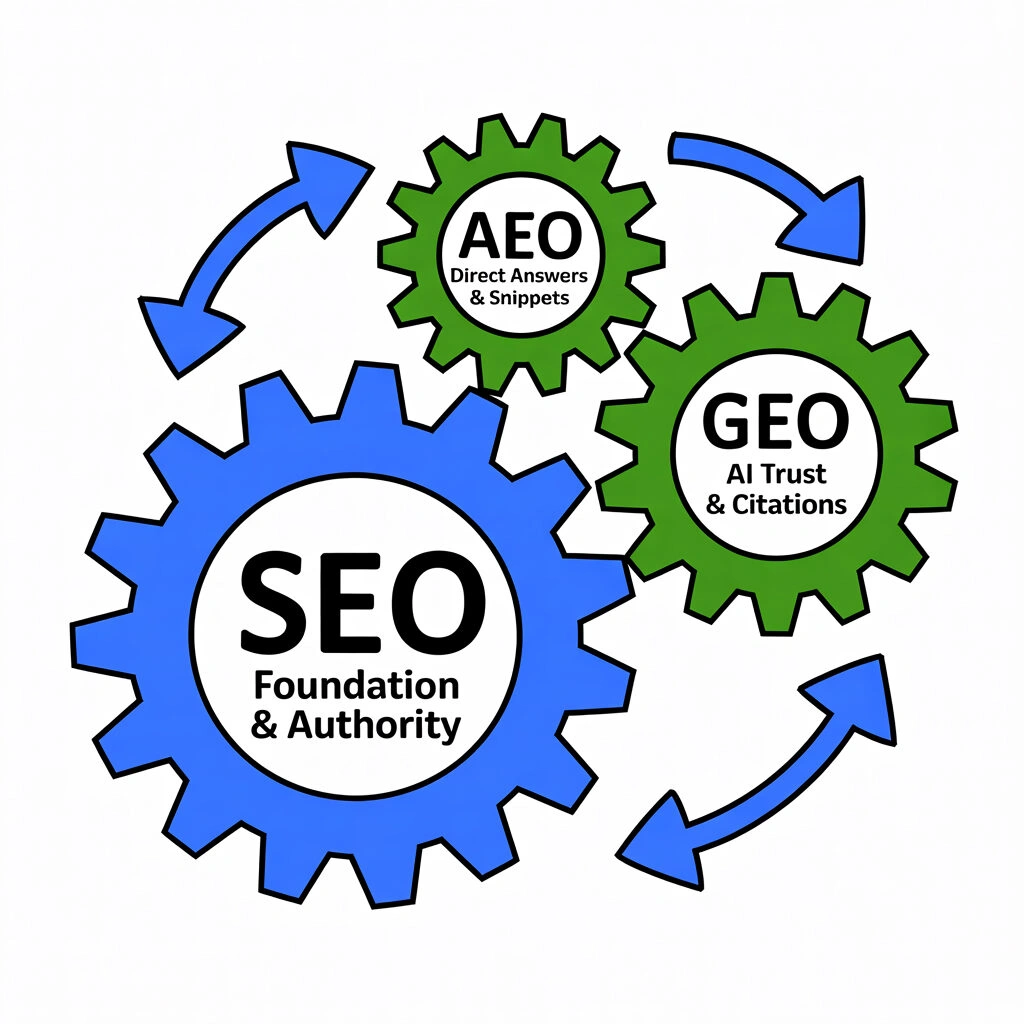
SEO, GEO and AEO describe overlapping ways of working with search. The labels are useful only when they help a business make a clear decision. They do not represent three separate systems that guarantee rankings, answers or AI citations.
For a Malaysian business, the practical task is still to make useful pages discoverable, answer the questions buyers actually ask, and measure whether search visits lead to worthwhile enquiries or sales.

SEO remains the foundation
Search engine optimisation (SEO) covers the work that helps search engines find, understand and present useful pages. It includes technical access and indexation, site structure, page content, local signals, and links or references that help people assess a business.

Start with the buyer’s task. Someone comparing providers needs different information from someone learning what a service does. A useful page answers the question at the right level, shows the service area and scope, and makes the next step clear. For Malaysian audiences, research whether people search in English, Bahasa Malaysia, Chinese or a mix. Do not assume that translating a keyword list is enough. The terms and questions may differ by language and context.
Technical work supports that content. Check that important pages return successfully, can be crawled and indexed, use clear internal links, and work on mobile. Use Search Console and analytics to find visibility and visitor patterns, then verify important findings against the page and the business’s own enquiry records.
AEO: answer the question clearly
Answer engine optimisation (AEO) is commonly used for work that helps a page provide a direct answer to a specific question. The label does not guarantee a featured answer or inclusion in an AI response.
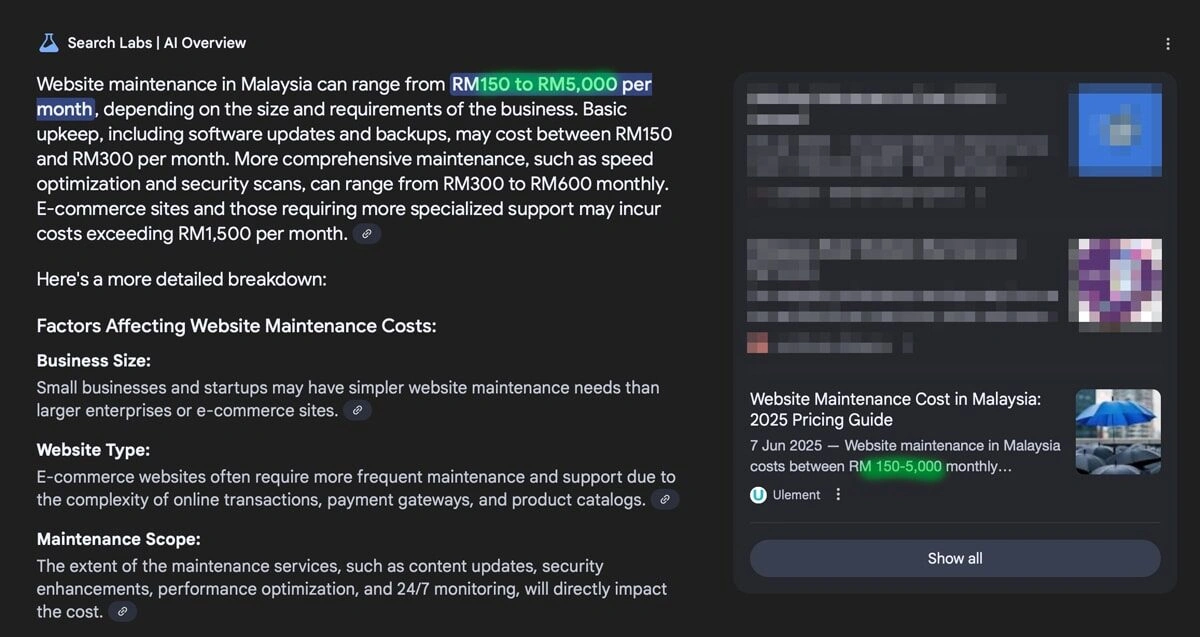
Give the short answer near the relevant heading, then explain the conditions, evidence and limits. Use descriptive headings, ordinary language and lists or tables where they make a comparison easier. Keep the full explanation on the page so a reader can judge whether the answer applies to their situation.
Do not create a page for every small wording variation. Group questions that share the same buyer need, and make each page useful enough to stand on its own.
GEO: visibility in generative search
Generative engine optimisation (GEO) is a broad industry term for improving the chance that content is surfaced or cited in generative search experiences. There is no separate GEO switch, and a business cannot guarantee that an AI system will mention or cite its page.

Google’s current guidance for its AI search features points site owners back to sound SEO practices: make content accessible for crawling and indexing, and publish original, useful material for people. Google also says no special optimisation or structured data is required for AI Overviews or AI Mode. Search interfaces and systems change, so monitor actual referrals and conversions rather than building a strategy around a promised citation.
Structured data has a useful technical role. It can present page meaning to crawlers in a more organised, machine-readable form. It must accurately describe information that the page says and shows. Valid markup can help systems understand a page and may enable supported search features, but it does not guarantee a rich result, higher rankings or AI citations.
Use one content and technical plan
Treat SEO, AEO and GEO as connected concerns within one plan:
- Identify the decision. Speak with sales and service teams, review real enquiries, and research searches in the languages your customers use.
- Choose the right page. Improve an existing page where it meets the same need. Create a new page only when it has a distinct purpose and enough useful information.
- Make the page understandable. State the service, audience, location, scope and next step. Support claims with evidence and explain qualifications.
- Check the technical delivery. Confirm crawling, indexation, mobile usability, internal links, page speed and accurate structured data where relevant.
- Review outcomes. Track impressions, clicks, qualified enquiries, sales and assisted conversions. Treat AI referrals as one possible source, not the whole measure.
This approach also limits content duplication. A clear page architecture is easier to maintain than separate pages written to chase every new search acronym.
What to measure
Search visibility is not the same as commercial performance. Use measures that match the goal:
- Discovery: indexed pages, impressions and relevant search queries.
- Engagement: visits to the intended page, useful next-page actions and contact starts.
- Commercial outcome: qualified enquiries, sales, booked appointments or another agreed conversion.
- Quality and ownership: accuracy, update responsibility, technical errors and the cost of maintaining the content.
Search Console reports Google Search performance. Web analytics can show what visitors do after arriving, subject to the site’s consent and measurement setup. Neither tool alone proves that one SEO change caused a business result. Compare periods carefully and consider other changes to the site, market and campaign activity.
Common mistakes
- Treating GEO or AEO as a guaranteed route to AI citations.
- Repeating keywords or publishing near-duplicate pages instead of answering a distinct need.
- Adding structured data that is hidden, irrelevant or inconsistent with visible content.
- Judging success by rankings or traffic alone when the business needs qualified demand.
- Using AI to produce pages at scale without original expertise, review or added value.
Frequently asked questions
Is GEO different from SEO?
GEO is a newer industry label for visibility in generative search. Its tactics overlap substantially with established SEO: accessible pages, useful original content and clear information. Specific search products may have their own guidance, so check current documentation rather than assuming one GEO formula applies everywhere.
Does AEO guarantee a featured snippet or direct answer?
No. Clear answers can help readers and search systems understand a page, but the search provider decides what to show and where.
Does structured data improve AI citations?
There is no guarantee that structured data will lead to an AI citation. Use it to describe visible page content accurately and to support a search feature when the page qualifies.
Should Malaysian businesses publish in several languages?
Only when customers need and the business can maintain those versions. Research language-specific intent, translate and review the complete page, use the correct language and regional signals, and keep each version current.
Conclusion
SEO provides the technical and content foundation. AEO encourages clear answers. GEO describes a wider concern about generative search visibility. Plan them together, keep claims accurate, and judge the work by useful outcomes rather than the latest acronym.
Sources checked on 20 October 2026: Google’s AI features and your website, guidance for succeeding in AI search, and general structured data guidelines.