Print copy often fails online for a simple reason: it expects the reader to begin at the beginning. Website visitors rarely do. They arrive through search results, service pages, shared links, and campaign landing pages, often without seeing the homepage first.
A brochure can build its argument across several pages. The cover creates interest, the next spread supplies context, and the final page presents the offer. A website cannot rely on that sequence. Each important page needs enough meaning to stand on its own.
My background began in advertising, so I understand why brand copy is carefully constructed. The wording carries tone, positioning, and years of internal discussion. Removing all of that would leave the website accurate but forgettable. The practical task is to keep the character while making the subject, evidence, and next step clear.
Key Takeaways:
- Print usually controls the reading sequence. Website visitors may enter through any indexed or shared page.
- Clear service names and descriptive headings help people and search engines understand the subject. They do not guarantee rankings or enquiries.
- Brand language still belongs on the page, but it should support meaning rather than carry the whole explanation.
- Existing pages need a baseline before substantial changes, especially when they already attract search traffic or enquiries.
- Measure whether the page helps the right person understand, decide, and act. Traffic alone is not enough.
Print controls the sequence. A website does not
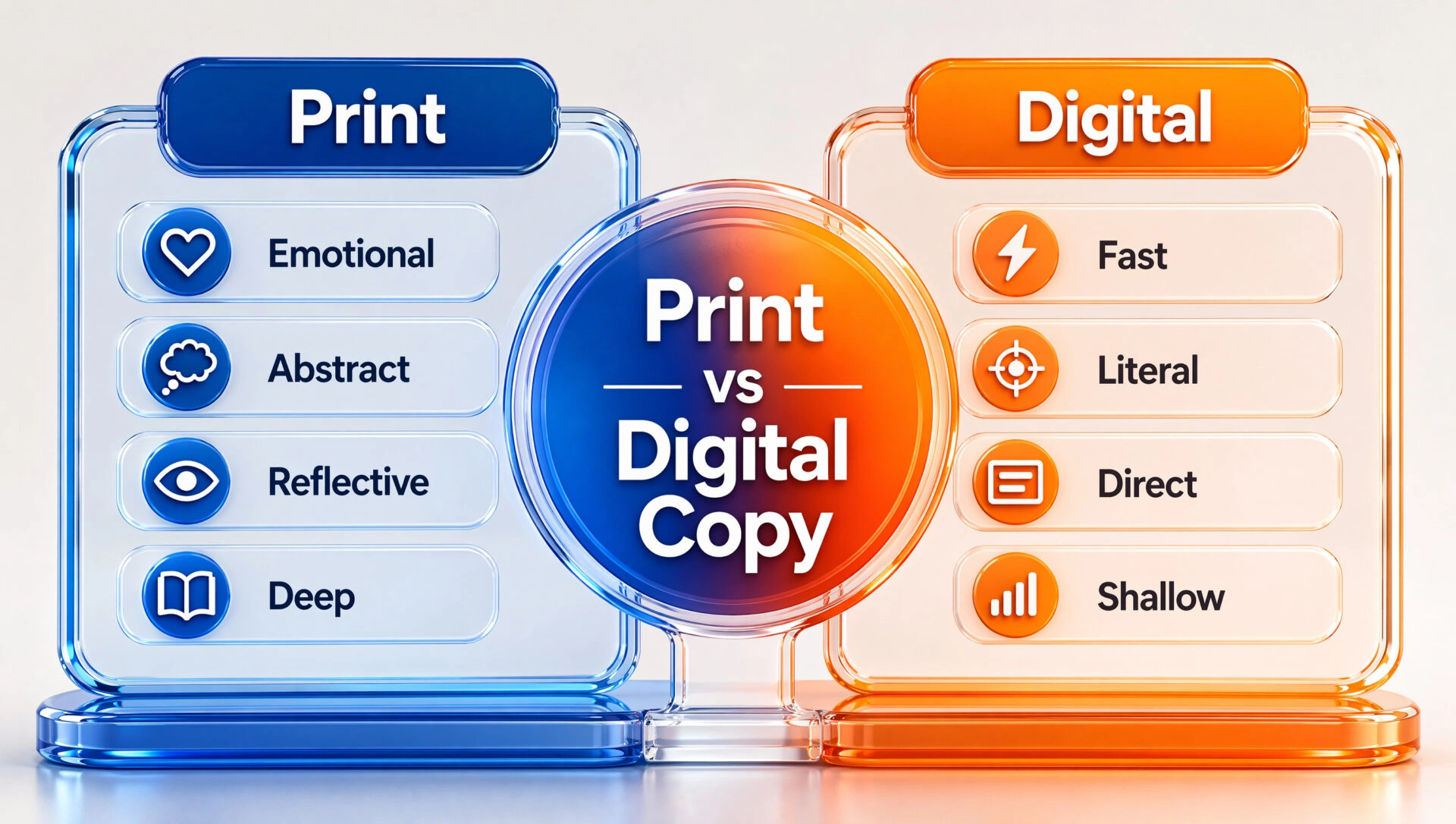
Print and web copy solve different reading problems. A brochure is usually received as a complete object. Its design can guide the reader from a broad brand idea towards products, evidence, and contact details.
A website is less orderly. Someone may land directly on a service page after searching for a specific problem. Another visitor may open an article shared by a colleague. A purchasing manager may scan only the headings before deciding whether the page deserves more time.
An early Nielsen Norman Group study on web reading found that 79% of its participants scanned new pages, while 16% read word by word. The study dates from 1997, so its figures should not be treated as a current universal benchmark. Its practical lesson remains useful: web pages need to reveal their structure quickly.
| Question | Print brochure | Website page |
|---|---|---|
| Where does reading begin? | Usually at the cover or first page | On any page reached through search, navigation, or a link |
| How is context supplied? | Across a designed sequence | Within the page and its surrounding navigation |
| How does the reader move? | Through a fixed order | By scanning headings, following links, and choosing a route |
| What must the copy establish? | Brand meaning and supporting detail | Subject, relevance, evidence, and next step |
| How should success be measured? | Recall, response, or campaign outcome | Qualified discovery, comprehension, action, and enquiry quality |
Search needs meaning, not a pile of keywords
Clear nouns matter because they tell a reader what the page covers. A heading such as “Designed for what comes next” may fit a campaign, but it does not identify the service, product, or problem. On its own, it asks the visitor to supply context that may not exist.
That does not mean every heading should repeat a search phrase. Google describes its ranking systems as favouring helpful, reliable content written for people. Its guidance also asks whether a page title or main heading gives a descriptive summary without exaggeration. Google’s people-first content guidance is more useful here than a mechanical rule about keyword density.
Search research can show how people describe a need. It can reveal that an internal service name is unfamiliar, or that customers use a more direct phrase. This is evidence, not a script. High search volume does not automatically make a term relevant, especially for a specialist business where a small number of qualified searches may matter more than broad traffic.
A useful page usually makes four things clear near the beginning:
- What the page is about.
- Who or what it is for.
- What problem, task, or decision it addresses.
- What the reader can do next.
The rest of the page should support those points with scope, evidence, limitations, and meaningful links.
Why paid SEM campaigns work differently
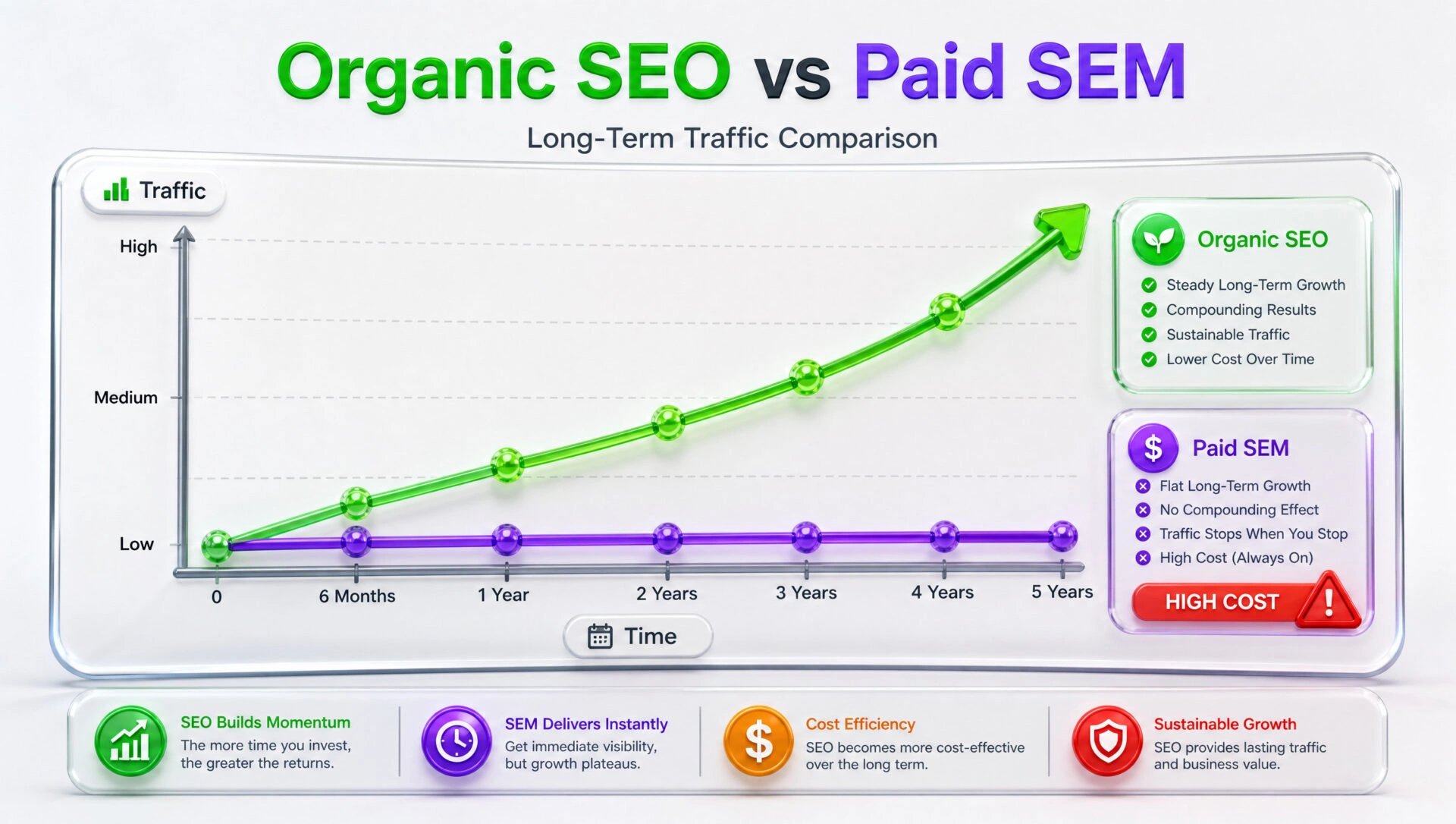
Search engine marketing (SEM) brings visitors through a campaign with defined targeting, adverts, budgets, and dates. Organic search is less controlled. A page may appear for several related queries, attract links over time, and receive visitors long after the original campaign has ended.
That difference changes the context around the copy. A paid advert can state the offer before the visitor reaches the landing page. The page can then focus on one audience, one promise, and one action. An organic page often has to establish more of that context for itself because the visitor may arrive through a query the organisation did not plan word for word.
Paid distribution does not make landing-page quality optional. Google describes Quality Score as a diagnostic rather than an input in the ad auction. Its components include expected click-through rate, ad relevance, and landing-page experience. The last of these considers whether the page is relevant and useful to the person who clicked the advert. Google’s explanation of Quality Score is a useful check against the idea that paying for traffic removes the need for clear copy.
Neither format is inherently better. Trouble begins when copy written for one reading pattern is placed into the other without restructuring it.
| Question | Paid search landing page | Organic search page |
|---|---|---|
| Where does reading begin? | Usually at the cover or first page | Through search results generated from a wider range of queries |
| How is context supplied? | Across a designed sequence | Usually needs to remain useful across related questions and entry paths |
| How does the reader move? | Through a fixed order | The title, search snippet, page content, and surrounding site |
| What must the copy establish? | Brand meaning and supporting detail | Qualified visibility, visits, actions, enquiry quality, and change over time |
| How should success be measured? | Recall, response, or campaign outcome | Visibility may continue, change, or decline as search demand and rankings move |
Paid pages can carry more campaign language when the advert has already made the offer clear. The message still needs to remain consistent from advert to landing page. Organic pages usually need more durable explanation because they serve discovery, comparison, and reference over a longer period.
Both channels need a clear offer, credible evidence, and a useful next step. The difference lies in how the reader arrives and how much context the page must supply.
Give brand language a clear job
Brand writing should shape how the organisation sounds. It can provide rhythm, point of view, and a phrase people remember. It becomes a problem when a visitor must decode it before understanding the offer.
Consider a brochure heading such as:
Built for what comes next
The line has tone but no subject. On a website, a descriptive heading can carry the meaning:
Website redesign for organisations with outdated content, navigation, or technology
The brand line can then appear in the supporting copy, where it adds character without hiding the service:
Keep what still works. Rebuild the structure that no longer supports the organisation.
This hierarchy gives each piece of writing a job. The heading establishes relevance. The introduction explains the situation. Evidence and scope help the reader assess the offer. Brand language gives the page its character.
Adapt the copy without flattening the brand
1. Define the page’s job
Decide what the reader should understand or do after reading the page. A homepage introduces the organisation. A service page helps someone assess a specific offer. A case study proves how a problem was handled. One page should not attempt all three jobs equally.
Write down the primary reader, their likely entry question, and the intended next step. This exposes gaps before anyone starts polishing sentences.
2. Name the subject early
Read the title, main heading, and opening paragraph without the design around them. Do they identify the service or subject? Would a new visitor understand the page after entering through search?
Replace internal labels and abstract headlines where they block meaning. Keep distinctive language when it adds clarity or tone.
3. Rebuild the reading order
Organise the page around the reader’s questions. Use descriptive headings, direct opening sentences, short paragraphs, lists where they improve scanning, and links that help the next decision.
Each section should still make sense if the reader skips the section before it. This is where brochure copy usually needs the most work. Its original sequence supplied context that the web page must now carry explicitly.
4. Restore voice, evidence, and limits
Once the structure is clear, bring back the language that makes the organisation sound like itself. Add proof where the page makes a claim. State limitations where the outcome depends on other systems, suppliers, or client decisions.
The final page should be clear without becoming generic. Accuracy and personality can coexist when they perform different jobs.
Existing pages need a baseline before substantial changes
Rewriting a page can affect search visibility, enquiries, and internal navigation. The level of checking should match the size and importance of the change. Correcting a confusing sentence is not a migration. Replacing the purpose and structure of a high-performing service page deserves more care.
Before changing an established page, record:
- the queries and pages bringing qualified search visits;
- the existing title, main heading, description, and page purpose;
- internal and external links pointing to the page;
- enquiry or conversion actions attributed to it;
- sections that answer recurring customer questions;
- the URL, canonical address, indexation state, and structured data.
Preserve what already works unless there is a documented reason to change it. After publication, check the rendered page, links, metadata, indexation signals, analytics, and enquiry path. Compare performance over a sensible period rather than treating an immediate fluctuation as proof of success or failure.
For a redesign or larger content change, a website migration and redesign SEO review can establish the baseline and post-launch checks. A routine copy edit should not be sold as a full migration exercise.
Measure whether the page helps someone decide
More traffic is useful only when it brings the right people and helps them complete a relevant task. A page can attract fewer visits while producing better enquiries. Another can rank for broad terms and contribute little to the business.
Measure the page against its job. Useful indicators may include qualified search impressions, visits from relevant queries, engagement with important sections, completed forms, calls, downloads, and the quality of resulting enquiries. User testing and sales-team feedback can reveal confusion that analytics cannot explain.
The measurement should answer a practical question: did the revised page make the offer easier for the intended reader to understand and act on?
Frequently Asked Questions
Can brochure copy be reused on a website?
Yes. It can provide useful source material, including approved claims, product details, brand language, and positioning. The content usually needs restructuring because website visitors scan and may enter through any page.
Does every page need keyword research?
No. Every page needs a clear purpose and language its intended readers understand. Search research is useful when it reveals how people describe the problem, but it should not force irrelevant or repetitive phrases into the copy.
Will rewriting website copy affect search rankings?
It can. The risk depends on what changes and how the existing page performs. Changes to purpose, headings, internal links, topical coverage, URLs, or indexation signals deserve baseline and post-publication checks.
Should a copywriter, developer, or SEO specialist handle the work?
The scope decides. A copywriter may handle wording and narrative. A search specialist can assess demand, page intent, and existing performance. A developer is needed when templates, structured data, navigation, accessibility, or publishing behaviour must change. Larger projects often need all three disciplines with one person accountable for the final system.
Can creative language appear in a website heading?
Yes, when the surrounding context makes the subject clear. A service page normally benefits from a descriptive main heading. More expressive language can then support the message in subheadings, introductions, examples, and campaign copy.
How do we know whether the rewrite worked?
Compare the result with the page’s original purpose and baseline. Check whether relevant visitors find the page, understand the offer, follow the intended route, and complete the next step. Do not use traffic volume as the only measure.
Clear web copy gives the brand a working structure
Print copy often carries useful thinking. The website fails when that thinking depends on a reading sequence, design context, or brand familiarity that the visitor does not have.
Start with the page’s job. Name the subject, organise the information around the reader’s questions, support claims with evidence, and then apply the brand voice. The result should still sound like the organisation. It should also work when someone arrives on the page with no other context.
If your website sounds polished but leaves people unsure what you do, request a website audit. The audit can identify whether the problem sits in the wording, page structure, search intent, navigation, or the wider platform.